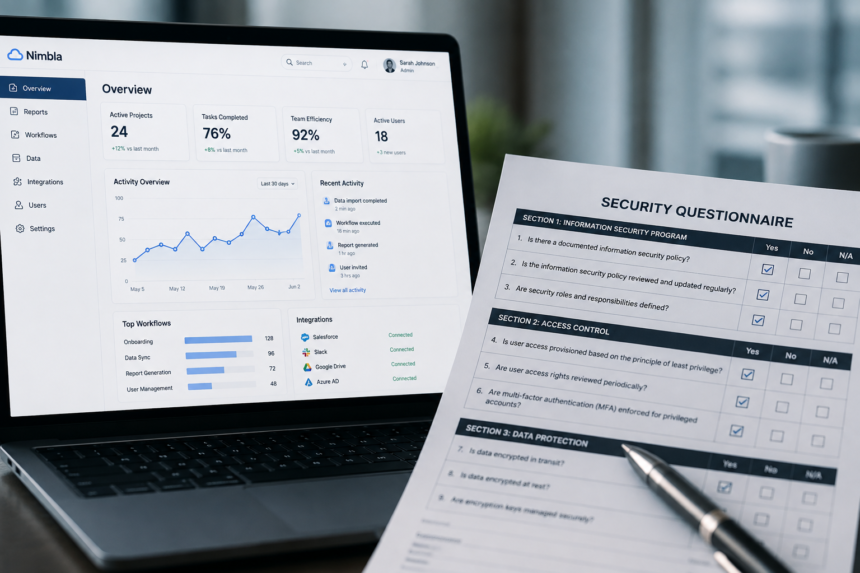

A founder we work with had just closed what looked like a done deal. Three demos, a champion inside the buyer’s org, verbal sign-off from the VP. Then the deal went quiet for six weeks. When it resurfaced, it wasn’t with a rejection, it was with a 40-question security questionnaire, half of which the founder didn’t have answers for. SOC 2 status: no. Data residency: unclear. Incident response plan: “we’ll get back to you.” The deal died there, not in the room.
This happens constantly in Indian B2B SaaS, and founders keep treating it as a late-stage surprise instead of what it actually is: a predictable, structural gate that most products aren’t built to pass.
Why Security Review Kills More Deals Than Bad Product-Market Fit
Founders obsess over the pitch, the demo flow, the ROI story, the objection handling. But for any deal above a certain contract value, procurement and security teams are the real second buyer, and they don’t care about your roadmap. They care about answerable, documented, boring things.
Compliance is table stakes, not a differentiator. SOC 2 Type II, ISO 27001, or ISO 42001 for AI products aren’t competitive advantages anymore, they’re the entry ticket. Not having them doesn’t just slow you down, it takes you out of consideration for anything enterprise.
Vague answers read as risk, not humility. When a founder says “we’re working on it” to a data residency question, the buyer’s security team hears “this vendor hasn’t thought about this.” That’s a worse signal than a hard no with a clear timeline.
Founders confuse “we’re a startup” with an excuse. Enterprise security teams have heard every version of “we’re small but scrappy.” It doesn’t buy goodwill. It buys a slower yes or a hard no.
What Enterprise Buyers Are Actually Screening For
Security and procurement reviewers aren’t reading your pitch deck. They’re checking a short, predictable list, and most SaaS founders don’t know it exists until they’re mid-deal.
They want a data flow diagram, where customer data lives, who touches it, what’s encrypted at rest and in transit. They want a subprocessor list, every third-party tool your product depends on, because their liability extends to your vendors. They want an incident response plan with actual named steps, not a paragraph about “taking security seriously.” And increasingly, especially post-2023, they want AI-specific disclosures: what model providers you use, whether customer data trains those models, and what happens if that provider has an outage or breach.
Building a Security Review Package Before You Need One
The founders who don’t lose deals at this stage built the package before the first enterprise prospect asked for it.
Start with a data flow diagram and subprocessor list, this takes a day, not a quarter, and most founders simply haven’t sat down to do it. Get SOC 2 Type I in progress early; even mid-audit status with a defined completion date is a legitimate answer buyers accept. Write an incident response plan that names actual people and actual steps, even if your team is five people. Keep a living answer sheet for the 20 most common security questionnaire items, data residency, encryption standards, backup frequency, access controls, so you’re not drafting answers live during a stalled deal.
None of this is expensive. It’s mostly documentation discipline applied early, instead of compliance panic applied late.
The Cost of Treating This as an Afterthought
The real cost isn’t the deal you lose, it’s the pattern. Enterprise sales cycles that stall at security review don’t just cost you that contract; they cost you the next six months of your sales team’s forecasting credibility, because “in security review” becomes the default state half your pipeline sits in indefinitely. Founders raising their next round also get burned here: investors ask about enterprise logos, and “we’re close on several, they’re in security review” is a weaker answer in month nine than it is in month three.
How Bridges & Blueprints Approaches This
This is the kind of gap we work with SaaS founders on directly, not writing security policy from scratch, but translating what a product actually does into the documentation, positioning, and messaging that enterprise buyers expect to see before they’ll move a deal forward. It’s less about compliance theater and more about making sure your product’s real maturity is visible at the exact stage buyers are looking for it.
FAQs:
Q: We’re pre-SOC 2, should we even try to sell to enterprise buyers right now?
Yes, but be upfront about it. Many enterprise buyers accept “SOC 2 Type I in progress, Type II targeted for [date]” as a real answer, especially if you pair it with strong interim documentation (data flow diagrams, encryption details, access controls). What kills deals isn’t lacking the certification, it’s having no answer at all.
Q: How much does a security review package actually cost to put together?
The documentation itself, data flow diagrams, subprocessor lists, incident response plans, costs founder time, not money, and can be done in days. SOC 2 Type I audits typically run $15,000–$40,000 depending on scope and auditor, which is a real cost but far cheaper than losing a six-figure ACV deal.
Q: Do smaller deals (under ₹10 lakh ACV) go through the same scrutiny?
Usually not to the same depth, but the trend is moving that way as more buyers standardize procurement regardless of deal size. It’s worth having baseline answers ready even for smaller deals, since you don’t always know upfront which prospects will escalate to formal review.
Q: What’s the single biggest documentation gap founders have?
A subprocessor list. Most founders don’t realize their liability extends to every third-party tool touching customer data, hosting providers, analytics tools, AI model APIs. Buyers ask for this constantly, and most startups have never written it down.
Q: Does using AI models (like OpenAI or Anthropic APIs) in our product make security review harder?
It adds a specific new layer of questions, not necessarily harder ones, buyers now routinely ask whether customer data trains third-party models, what happens on model provider outages, and whether you have contractual data protections with your AI vendors. Having clear, honest answers here matters more than having a particular vendor.